


Contents
What is SaP?
					“a collaborative, reciprocal process through which all participants have the opportunity to contribute equally, although not necessarily in the same ways, to curricular or pedagogical conceptualisation, decision making, implementation, investigation, or analysis”

(Cook-Sather, Bovill & Felten, 2014, pp. 6-7).
					“A relationship in which all involved—students, academics, professional services staff, senior managers, students’ unions, and so on—are actively engaged in and stand to gain from the process of learning and working together”

(Healey, Flint, & Harrington, 2014, pp. 12)
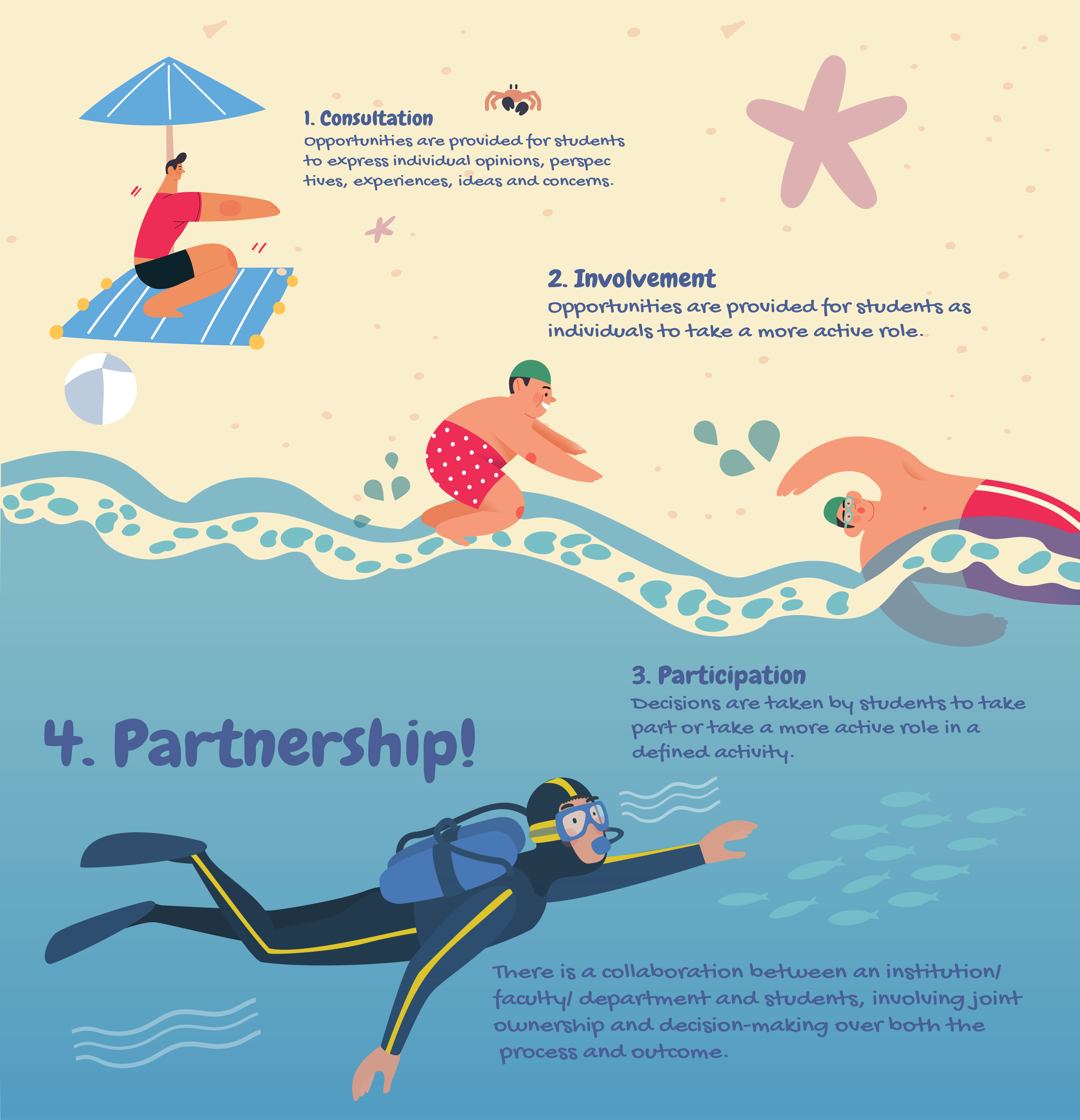
Four Stages of Student Engagement
Why SaP?
Student Partnership aims to gather faculty and students “to design and deliver engaging student learning experiences” (Healey et al., 2015, p.15). SaP recognizes that students are more likely to be motivated and engaged in their learning when they are given an active role in the design and implementation of the learning experience. By involving students as partners in the decision-making and implementation process, SaP creates a more collaborative and engaging learning experience that empowers students to take ownership of their own learning.
Another important goal of SaP is to enhance the current teaching and learning experiences by promoting a more inclusive and student-centred focus. In the process of partnership, diverse inputs are gathered to contribute to the final decision, recognizing the value of unique perspectives and experiences of students. SaP recognizes that students have individual differences in their learning needs and interests, and aims to create a learning experience that is more relevant and responsive to these differences. By involving students as partners in the design and implementation of the learning experience, SaP promotes a more student-centered approach to teaching and learning that values collaboration and recognizes the importance of student input throughout the process.
Benefits of SaP
To Students
- Raise student engagement/ motivation/ownership for learning
- Increase student confidence/self-efficacy
- Deepen students’ learning through reflective activities
- Promote reciprocal understanding of experiences between students and staff
- Enhance relationship and trust between student and staff
- Become active agents and take more responsibility for their learning
To Staff
- Produce new thinking about, and understanding of, teaching
- Enhance relationship and trust between student and staff
- Develop new or better teaching or curriculum materials
- Change of perception/ induced new beliefs about teaching and learning that change practice for the better
- Induce a reconceptualization of teaching and learning as a collaborative process
What’s Next?
- Tips to start a SaP project
- Approaches of including students in your T&L projects
- For more, stay tuned!
References
- Cook-Sather, A., Bovill, C., & Felten, P. (2014). Engaging Students as Partners in Learning & Teaching: A Guide for Faculty. San Francisco: Jossey-Bass.
- Healey M, Bovill C and Jenkins A (2015) Students as partners in learning, in Lea J (ed) Enhancing learning and teaching in higher education: Engaging with the dimensions of practice, pp.141-163. Maidenhead: Open University Pres.
- Healey, M., Flint, A., & Harrington, K. (2014). Students as partners in learning and teaching in higher education. York: Higher Education Academy.
- Mercer-Mapstone, L., Dvorakova, S.L., Matthews, K.E., Abbot, S., Cheng, B., Felten, P., Knorr, K., Marquis, E., Shammas, R., and Swaim, K. (2017) A Systematic Literature Review of Students as Partners in Higher Education. International Journal for Students as Partners. 1(1).