


The landscape of educational technology is fast evolving in the age of Artificial Intelligence, invigorating the emergent trend of human-AI collaboration in instructional design. The human-AI collaborative approach leverages AI’s capabilities to supplement instructor productivity and creativity, transforming how teachers and instructional designers create and curate contents in the intelligent immersive learning environment.
Artificial intelligence is well suited to address teachers’ diverse needs by supporting individual students’ learning progress, delivering timely feedback on students’ work, gaining insights from student analytics to enhance interactivity, as well as generating content tailored to specific learning contexts and scenarios to improve students’ learning experiences (Wen et al., 2025).
AI breathes life into history learning

In a recent HKU massive open online course for global learners titled “The Evolution of Civilization”, teachers and instructional designers partnered with AI to develop context-aware content that engages students on multiple levels. For instance, by reconstructing historical scenes and events from over 2000 years ago to the present day, students may feel a deeper imagination and immersion in the historical course material. This capability allows educators to bring history to life, making it more relatable and memorable for learners. The use of AI aids in crafting and fleshing out real-life scenarios, such as simulating the ancient food sources of tribal communities, to provide students with a palpable connection to past civilisations.
Visualization enhances understanding of abstract concepts

Additionally, AI-driven animation can illustrate complex and abstract concepts, enabling better visualization and comprehension. For example, an animated image leveraging AI technology can clearly depict an abstract market concept illustrating key concepts of how urban density deepens and widens markets by increasing accessibility and city flow, consequently bringing in more skilled people and specialized goods.
Visual coherence made simple

AI is also a useful assistant in developing consistent imagery for flow diagrams and feedback loops, ensuring visual coherence throughout the course. This not only streamlines the instructional design process but also enhances the overall learning experience by providing clear and visually appealing course materials. By integrating AI into course design, teachers can more effectively tailor content to meet diverse learning requirements and support more personalised student learning experiences.
Efficiency matters
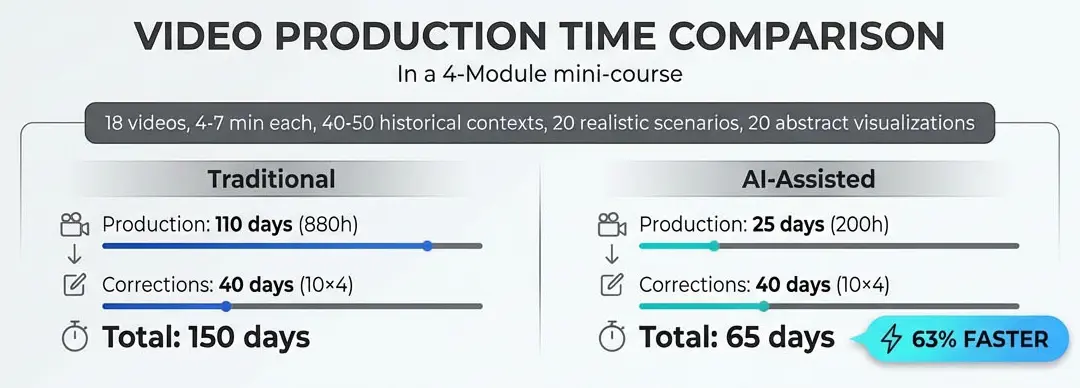
Harnessing the potential of Human-AI collaboration through advanced AI models and prompts revolutionizes the creative process for teachers and instructional designers, unleashes boundless possibilities for generating context-aware material. In the MOOC production workflow, this partnership enables the generation of high-quality, context-specific multimedia content, reducing production time by over 60%. The utilization of AI alleviates the burdens of traditional workflows, which often demand extensive manual illustration and sourcing of stock images. Embracing AI as a collaborative partner streamlines the education design process and empowers teachers to focus on creativity and students’ experiences.
> Learn more
Reference:
Huang, P. W., & Hwang, Y. L. (2025). The effectiveness of AI-integrated VR oral training application in reducing public speaking anxiety and interview anxiety. Computers and Education: Artificial Intelligence, 100514.
Rodero, E., & Larrea, O. (2022). Virtual reality with distractors to overcome public speaking anxiety in university students. Comunicar: Media Education Research Journal, 30(72), 85-96.
Robert, J., Muscanell, N., McCormack, M., Pelletier, K., Arnold, K., Arbino, N., Young, K., & Reeves, J. (2025). The 2025 EDUCAUSE Horizon Report | Teaching and learning edition. EDUCAUSE.