
AI is Transforming Education Design

The landscape of educational technology is fast evolving in the age of Artificial Intelligence, invigorating the emergent trend of human-AI collaboration in instructional design. The human-AI collaborative approach leverages AI’s capabilities to supplement instructor productivity and creativity, transforming how teachers and instructional designers create and curate contents in the intelligent immersive learning environment. 

Artificial intelligence is well suited to address teachers’ diverse needs by supporting individual students’ learning progress, delivering timely feedback on students’ work, gaining insights from student analytics to enhance interactivity, as well as generating content tailored to specific learning contexts and scenarios to improve students’ learning experiences (Wen et al., 2025).

AI breathes life into history learning

In a recent HKU massive open online course for global learners titled “The Evolution of Civilization”, teachers and instructional designers partnered with AI to develop context-aware content that engages students on multiple levels. For instance, by reconstructing historical scenes and events from over 2000 years ago to the present day, students may feel a deeper imagination and immersion in the historical course material. This capability allows educators to bring history to life, making it more relatable and memorable for learners. The use of AI aids in crafting and fleshing out real-life scenarios, such as simulating the ancient food sources of tribal communities, to provide students with a palpable connection to past civilisations.

Visualization enhances understanding of abstract concepts

Additionally, AI-driven animation can illustrate complex and abstract concepts, enabling better visualization and comprehension. For example, an animated image leveraging AI technology can clearly depict an abstract market concept illustrating key concepts of how urban density deepens and widens markets by increasing accessibility and city flow, consequently bringing in more skilled people and specialized goods.

Visual coherence made simple

AI is also a useful assistant in developing consistent imagery for flow diagrams and feedback loops, ensuring visual coherence throughout the course. This not only streamlines the instructional design process but also enhances the overall learning experience by providing clear and visually appealing course materials. By integrating AI into course design, teachers can more effectively tailor content to meet diverse learning requirements and support more personalised student learning experiences.

Efficiency matters

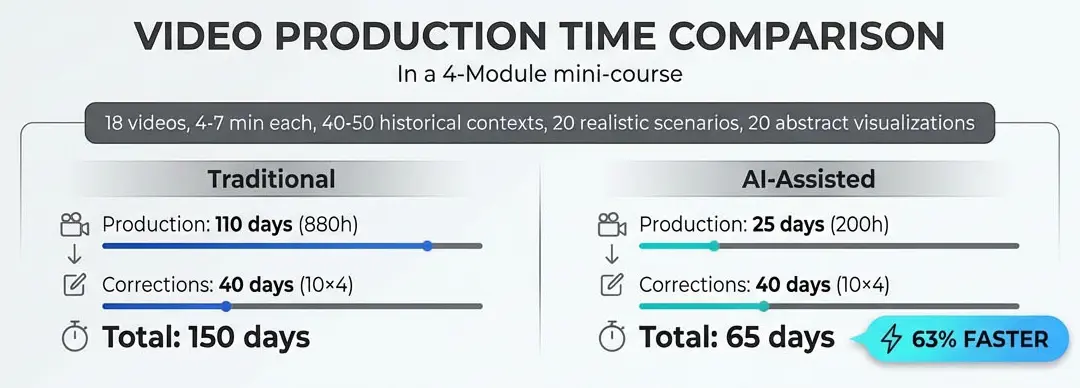
Harnessing the potential of Human-AI collaboration through advanced AI models and prompts revolutionizes the creative process for teachers and instructional designers, unleashes boundless possibilities for generating context-aware material. In the MOOC production workflow, this partnership enables the generation of high-quality, context-specific multimedia content, reducing production time by over 60%. The utilization of AI alleviates the burdens of traditional workflows, which often demand extensive manual illustration and sourcing of stock images. Embracing AI as a collaborative partner streamlines the education design process and empowers teachers to focus on creativity and students’ experiences.
Reference:

  • Huang, P. W., & Hwang, Y. L. (2025). The effectiveness of AI-integrated VR oral training application in reducing public speaking anxiety and interview anxiety. Computers and Education: Artificial Intelligence, 100514. 

  • Rodero, E., & Larrea, O. (2022). Virtual reality with distractors to overcome public speaking anxiety in university students. Comunicar: Media Education Research Journal, 30(72), 85-96.

  • Robert, J., Muscanell, N., McCormack, M., Pelletier, K., Arnold, K., Arbino, N., Young, K., & Reeves, J. (2025). The 2025 EDUCAUSE Horizon Report | Teaching and learning edition. EDUCAUSE.

AI Transparency Statement: The author(s) used [ChatGPT, DELL-E3, Kling2.5] during the preparation of this work to produce multimedia learning materials in course development. After utilising the tool/service, the author(s) thoroughly reviewed and edited the content as necessary and assumed full responsibility for the publication’s content.

Teaching Exchange Fellowship Scheme Seminar – Grants for overseas reciprocal visits through ‘Teaching Exchange Fellowship Scheme’

Event Details

Date : 8 Jan 2026 (Thu)

Time : 1:00pm – 2:00pm

Venue : Learning Lab (RRS 321, 3/F, Run Run Shaw Building, Main Campus, HKU)

Chairman : Prof. Olivia Leung, Associate Dean (Teaching and Learning), HKU Business School

Facilitator : Prof. Luke Fryer, Assistant Director, TALIC, HKU

Abstract

Grants for overseas reciprocal visits through ‘Teaching Exchange Fellowship Scheme’

To encourage HKU staff to introduce new ideas and innovative teaching methods by engaging with teachers from overseas universities, HKU has established the “Teaching Exchange Fellowship Scheme”. Under this scheme, HKU will provide funding up to $50,000 for reciprocal staff visits and a teaching relief grant of up to $60,000 may also be awarded to successful applicant’s department.

A seminar will be organized, open to all teaching staff, to offer a comprehensive overview of this funding scheme. The seminar aims to provide information on key objective, funding amounts, eligibility and application process. Additionally, it will offer valuable advice on preparing a successful application and guide participants on planning exchange visits to enhance the scholarship of teaching at HKU, which is the aim of the scheme. The seminar will also showcase examples, on how this funding opportunity can be used by HKU teaching staff to share experience and to collaborate on teaching and curriculum development initiatives with overseas reputable universities through reciprocal visits.

We highly recommend that staff who are considering applying for the scheme to attend the seminar. It will be beneficial for staff who attended the last seminar but didn’t have sufficient time to establish overseas connections, as well as those who are planning ahead for next application cycle (having a Wednesday, February 25, 2026 closing date), would also find the seminar useful. If you are unsure whether the scheme align with your teaching innovations, or if you simply want to learn more about it, you are welcome to attend. For further information, please refer to the Circular on this scheme available at https://tl.hku.hk/staff/tefs/.

For information, please contact:

Ms. Canice MOK

Teaching and Learning Innovation Centre

GenAI from Simple Chat to Apps, Bots, and Workflows

Event Details

Date : 18 Dec 2025 (Thu)

Time : 12:00nn – 2:00pm

Venue : Learning Lab (RRS 321, 3/F, Run Run Shaw Building, Main Campus, HKU)

Speaker : Mr. Chun-Ho Hung, Software Engineer, Poe Team, Quora Inc.

Facilitator : 

  • Dr. Jessica To, Lecturer, TALIC, HKU
  • Dr. Elvis Ng Wang Hei, Assistant Lecturer, Department of Pharmacology and Pharmacy, Li Ka Shing Faculty of Medicine, HKU

Abstract

This beginner friendly session introduces practical ways to use Generative AI (GenAI) with Poe that go beyond simple chat. It brings together many of the best AI models (GPT, Gemini, Claude, Nano-Banana-Pro) across text, image, video, and audio into a single interface, so participants can explore powerful tools without needing to juggle multiple accounts or platforms.

Focusing on simple, real-world examples, the workshop will show how Poe can help organize and support everyday academic and professional tasks at HKU:

  • how Canvas apps (built with Poe’s App Creator) can turn plain language ideas into interactive web applications for drafting, refining, and organizing work;
  • how prompt bots let you build custom bots on top of frontier models using a single text description;
  • how script bots and script creator can start to automate simple, repetitive processes while remaining accessible to non-specialists; and
  • how Poe’s OpenAI compatible chat completions API makes it possible to call any model or bot on Poe from your own tools and projects.

The session will also briefly highlight new collaboration features like group chat, which allow participants to work with others and multiple AI models in a single shared conversation.

No programming background or prior experience with Poe is required. Through live demonstrations (including Canvas apps, App Creator, and example API usage), discussion, and Q&A, the session aims to build confidence, clarify what GenAI can achieve, and offer a small set of concrete starting points that participants can adapt to their own work contexts.

Participants could bring their notebook computer to do hands-on practice during the workshop.

About the Speaker

Mr. Chun-Ho Hung is a software engineer on the Poe team at Quora, where he builds the Poe API and platform that enable everyone to access frontier generative AI models. He has over a decade of industry experience, including as a software engineer at Google, working on the next generation of planet-scale distributed backend infrastructure for products such as Google Search and YouTube, and as a backend engineer at Robinhood, supporting the company’s hypergrowth stage. He holds a BSc in Computer Science and an MPhil in Computer Science and Engineering from The Chinese University of Hong Kong.

Co-host

Li Ka Shing Faculty of Medicine, HKU
For information, please contact:

Ms. Canice MOK

Teaching and Learning Innovation Centre